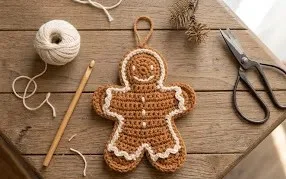
Easy Gingerbread Man Ornament Free Crochet Pattern
Soft yarn, a rounded head, and little icing-style details give a crocheted gingerbread man the cozy look of a cookie without the crumbs. This small ornament suits beginners who want practice with basic stitches, gift makers putting together handmade holiday packages, and anyone who likes adding personal touches to a tree or wreath. The project is satisfying because its familiar shape takes form in a short time, and a few embroidered features give each face its own expression. You’ll learn how single crochet builds a firm fabric, how simple shaping creates the gingerbread silhouette, and how to finish the piece with details and a hanging loop. Use classic brown with white trim, or choose colors that match your holiday decorations.
Why You’ll Love This Pattern
A firm cotton dishcloth is useful at the sink, and its simple single-crochet rows make this a steady project to work on between other tasks. The finished cloth measures about 8 inches square when you match the gauge, so it is large enough for everyday washing without taking much yarn.
- The pattern uses one stitch throughout, which makes it a good first project for practicing even tension.
- A single ball of worsted cotton is usually enough, and leftover cotton can work if you have at least 100 yards.
- The flat shape is easy to check as you go. There are no seams, increases, or decreases to manage.
- A finished cloth is useful as a kitchen item or a small handmade gift. Make a set in colors that suit the recipient.
The rows were easy to keep track of, and the cotton made a sturdy cloth. I finished mine over two evenings.
— Lena, weekend crocheter
Pattern Overview & Skill Level
- Skill Level: Beginner. You need to chain and make single crochet stitches.
- Approximate Time: 2–3 hours, depending on your pace and experience.
- Construction: Work a flat rectangle in rows, turning at the end of each row. A single-crochet border finishes the edges.
- Finished Dimensions & Sizing: About 8 × 8 inches (20 × 20 cm) after washing and drying flat. The pattern is written for this size.
Materials & Supplies Needed
- Yarn: About 100 yards of worsted-weight (#4) 100% cotton yarn. Choose one color, or use cotton scraps joined at row ends. Cotton absorbs water and holds up well to regular washing.
- Hook Size: 5.0 mm / H-8 crochet hook. Use the size that gives you the stated gauge.
- Notions: Tapestry needle for weaving in ends, scissors, and a ruler or tape measure. A stitch marker is optional for marking the first stitch of a row.
- Substitutions: A similar-weight cotton or cotton blend is the closest substitute. A thinner yarn makes a smaller, lighter cloth; a bulkier yarn makes a larger, thicker cloth and uses more yardage. Acrylic yarn is less absorbent than cotton, so it is not the best choice for a dishcloth.
Gauge: 16 single crochet stitches and 18 rows measure 4 inches (10 cm) square, worked flat. Check your gauge before starting. If you have more stitches per 4 inches, try a larger hook; if you have fewer, try a smaller hook.
Stitch Guide & Abbreviations (US Terms)
- ch: Chain.
- sc: Single crochet. Insert the hook into the stitch, yarn over and pull up a loop, yarn over again and draw through both loops.
- st(s): Stitch(es).
- sl st: Slip stitch. Insert the hook into the stitch, yarn over, then draw the yarn through the stitch and the loop on the hook.
- rep: Repeat.
- RS: Right side, the face of the fabric you want to show.
The turning chain does not count as a stitch. Work the first single crochet into the first stitch of each row to keep the edges straight.
Step-by-Step Pattern Instructions
Dishcloth
Foundation: Ch 33. The extra chain gives you room to turn; it does not count as a stitch.
Row 1: Sc in the second ch from the hook and in each ch across. Turn. (32 sts)
Row 2: Ch 1, sc in each st across. Turn. (32 sts)
Rows 3–36: Repeat Row 2. At the end of every row, you should have 32 stitches. After Row 36, do not turn.
To check the size, the unbordered piece should measure close to 8 inches wide and 8 inches tall at the stated gauge. If it is noticeably wider or narrower, check your stitch count and tension before finishing.
Border and Finishing
- Ch 1, then work one sc in each stitch across the top edge. At the corner, work 3 sc into the corner stitch.
- Work 1 sc evenly down the side edge, placing approximately 1 sc in the end of each row. Keep the spacing even rather than forcing a stitch into every small gap. Work 3 sc in the corner.
- Work 1 sc in each foundation chain across the bottom edge, then 3 sc in the corner.
- Work 1 sc evenly up the remaining side edge. Join to the first sc of the border with a sl st. Fasten off, leaving a short tail.
- Thread the tail onto a tapestry needle and weave it through several stitches on the wrong side. Weave in the starting tail the same way. Trim the ends close without cutting the fabric.
- Wash the cloth according to the yarn label and dry it flat. Smooth the edges while damp so the square lies evenly.
Care & Washing Instructions
- Wash cotton in warm water, up to 40°C (104°F), unless the yarn label gives a lower limit.
- Dry flat or tumble dry on low if the yarn label permits; reshape the square while it is damp.
- Block lightly by smoothing the edges flat. Avoid stretching the cloth, which can make the stitches look uneven.
Pro Tips & Common Mistakes to Avoid
- Keep your tension relaxed but consistent. Tight single crochet can make the cloth stiff and smaller than the finished dimensions; a looser fabric will be softer but may stretch more.
- Count the 32 stitches at the end of each row. If you tend to miss the last stitch, place a marker in the first stitch of the row before turning.
- Do not crochet into the turning chain. It is not a stitch in this pattern; working into it can add stitches and make the edge flare.
- To change the size, add or remove foundation chains while keeping an odd number, then work one fewer single crochet than the chain count. Each additional stitch adds about ¼ inch to the width at gauge. More rows add height and use more yarn; make a small test swatch if you need an exact size.
Frequently Asked Questions
Can I use a different yarn fiber?
Cotton is the best fit because it is absorbent and washable. A cotton blend can work, but check its care label. Acrylic is less absorbent and may not perform as well for washing dishes.
How can I make the dishcloth larger or smaller?
Change the number of foundation chains for the width and the number of rows for the height. Keep the stitch count even from row to row, and expect a larger cloth to use more yarn than the 100-yard estimate.
Is this pattern suitable for a first crochet project?
Yes. It uses chains and single crochet in flat rows, with no shaping. Practice the first few rows slowly and check that each row has 32 stitches before continuing.
May I sell dishcloths made from this pattern?
You can sell finished items only if the designer’s terms allow it. If you plan to sell yours, check the applicable pattern terms and describe the item as handmade rather than claiming authorship of the pattern.
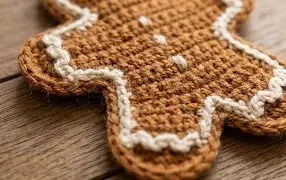
Your little gingerbread figure is ready to bring a handmade touch to a tree, gift tag, or holiday garland, with its soft shape and cheerful stitched details. For a simple variation, change the yarn color or use a smaller hook and finer yarn to make a petite version. Keep the tension even so the stuffing stays covered, and leave a sturdy loop for hanging. If you make one, share a photo on Pinterest or your favorite social media platform so others can see your colors and finishing touches. Then explore more free crochet patterns on the blog for your next small handmade project.